
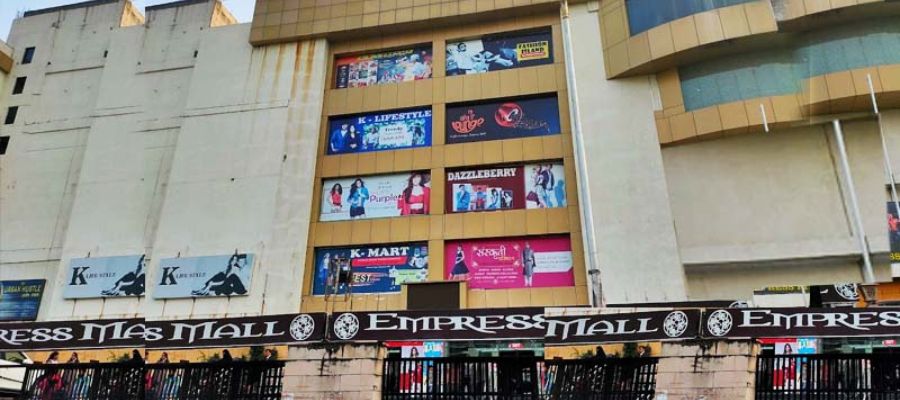
Empress City Mall, Nagpur: The City’s Favourite All-Under-One-Roof Escape
Nagpur has never been a city that does things quietly. It is loud, warm, opinionated about its food, and deeply loyal to its neighbourhoods. So when a mall lands in the middle of a city like this — not on some distant peripheral highway but close to the beating heart of the old town, near the Railway Station area where the city has been doing business for well over a century — it either earns its place or it doesn’t. Empress City Mall, for most Nagpurians, has earned it.
A Location That Actually Makes Sense
The mall sits adjacent to what was once the old cotton mill grounds — a detail that says more about Nagpur’s economic history than most guidebooks bother to mention. The city built much of its early modern identity around the textile trade, and the mill areas that once hummed with industrial activity have quietly given way to a different kind of commerce. There’s something fitting about that transition: the same central location, now serving a city that has moved from manufacturing to retail, entertainment, and services.
Proximity to the Railway Station means Empress Mall draws from a wide catchment — not just residents of the immediate neighbourhood, but people arriving from across Vidarbha, travellers with a few hours between trains, families from smaller towns who’ve come to the city specifically for a day out. It is, in this sense, a genuinely regional destination rather than just a neighbourhood convenience.
What’s Inside
Empress City Mall covers the full spectrum of what a well-rounded urban mall should offer without overcomplicating the experience. The retail floors bring together a mix of national brands and local favourites — clothing, footwear, electronics, and the usual anchor stores that give a mall its commercial backbone. It’s the kind of lineup that means most people can find what they came for without having to visit three different parts of the city.
The multiplex is a serious draw. Nagpur takes its cinema culture seriously, and having a well-maintained, comfortable theatre within a larger shopping complex means an evening out can unfold naturally — dinner, a film, dessert — without any logistical juggling. On weekends especially, the multiplex tends to draw its own crowd independent of the retail floors.
The food court operates as its own small universe. Nagpur’s food identity is specific and proud — the city is serious about its saoji curries, its tarri poha, its orange-based everything — and while a mall food court inevitably skews toward the familiar national fast-food chains, there’s usually enough local flavour woven in to keep things honest. It is the kind of space where family groups fan out in different directions and reconvene with vastly different trays of food, which is more or less the definition of a food court doing its job correctly.
The kids’ zones give parents an actual answer to the question of what to do with younger children while the adults shop or eat. This is not a minor amenity — it is, for many families, the deciding factor in choosing one destination over another on a Sunday afternoon.
The Mall as Urban Breathing Room
There’s a version of the mall-criticism argument that applies to some cities but sits awkwardly in the context of somewhere like Nagpur. The argument goes that malls are sterile, that they replace authentic street culture with climate-controlled homogeneity. In cities where street markets are thriving and pedestrian life is comfortable year-round, that critique has some traction.
In Nagpur — a city that genuinely bakes in the summer, where May temperatures regularly push past 45°C and outdoor activity between noon and 6 p.m. becomes something of a medical decision — an air-conditioned, well-maintained indoor space is not a cultural imposition. It is a legitimate urban necessity. Empress Mall, in its central location and range of offerings, fills that role without pretension.
It is the kind of place where a retired couple can spend a slow Tuesday afternoon walking the floors and stopping for coffee. Where college students from nearby institutions treat the food court as an extended common room. Where families from the Vidarbha region, visiting the city for weddings or medical appointments or school admissions, find a familiar, manageable environment for a few hours of leisure. None of these uses are glamorous, but all of them matter.
Practical Notes for Visitors
Empress City Mall is accessible by auto-rickshaw and city bus from most parts of Nagpur, with the Railway Station proximity making it easy to reach from the city’s main transit hub. Parking is available for those arriving by car or two-wheeler. The mall follows standard operating hours through the week, with slightly extended hours on weekends to accommodate evening crowds.
For first-time visitors from outside Nagpur, the location near the station makes it a logical first stop or last stop on a city visit — somewhere to eat, pick up what you need, and decompress before or after the journey without having to navigate the broader city unnecessarily.
Empress City Mall is not trying to be the most glamorous address in Maharashtra. It is trying to be reliably useful, comfortable, and worth the visit — and in a city that values practicality as much as Nagpur does, that turns out to be exactly enough.